
















Camp Buddy



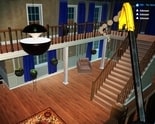






In Camp Buddy you start with a single character in a bare dorm room, a class schedule already ticking at the top of the screen, and no dialogue beyond a note telling you to get to homeroom — a blunt condition that matters, since everything this build offers grows out of that morning-to-evening loop rather than any story told upfront.
The Daily Schedule Loop That Camp Buddy Runs On
The core mechanic is simple: move your character between a handful of fixed locations — homeroom, the courtyard, the cafeteria — while a clock in the corner pushes the day forward. Nothing punishes standing still, and that low-stakes pacing is what a slice-of-life school game promises when played straight, no dating-sim layer underneath.
Anyone searching what Camp Buddy is about should know the build behind this page is not the visual novel some expect from the name. It plays as a generic school-day sim — attend a lesson, cross the courtyard, sit through lunch, get sent back to the dorm once the clock runs out.
There is no romance track, no relationship meter, and no named love interest in the interface, which answers the other question new players ask: no, nothing here plays like a dating sim, and none of the character routes tied to the bigger name show up in this version.
Why the Cafeteria and Courtyard Blend Together in Camp Buddy
Camp Buddy leans on three reused locations — the courtyard, the cafeteria, and a single classroom — and players expecting a sprawling campus instead get a tight loop some slice-of-life fans would call a “cozy sim” skeleton: repeatable, low-friction, short on surprises.
The cast is small too, a few classmates scattered around the courtyard and cafeteria rather than a full roster with backstories, answering the common question about how many characters populate the build: not many, and none carry a storyline of their own.
That thinness is the most divisive part of the build. Players hunting for the deeper school-life experience the display name implies tend to bounce off within a single day, while those wanting an undemanding click-through find the loop oddly relaxing rather than empty.
What the Small Cast of Classmates Actually Offers
Open block: the afternoon slot where the schedule loosens and you can walk between courtyard and cafeteria without a lesson forcing you back — the closest thing to open exploration.
Homeroom: the fixed morning stop that starts every loop, doubling as the only screen carrying real dialogue text.
Curfew screen: the evening cutoff that ends the day and resets the schedule, the closest thing to a goal even though it isn’t a defeat. Achievement-minded players notice the loop caps fast, since curfew just repeats the schedule instead of unlocking anything new.
Camp Buddy, at least in the build on this page, is best approached as a short, honest school-day loop rather than the story-driven game its name suggests — read the schedule, walk between homeroom and the courtyard, and let the curfew screen close the day out.